Thanks to a tip from one of our readers (thanks Gerard!), it appears that there’s a huge data outage for Nexus Owners (s goog) on the T-Mobile network. I’ve verified the issue on my own Nexus One and just did a little digging. According to forums at both T-Mobile and XDA-Developers, it’s a wide scale issue and nobody seems to have an answer. One would hope that this has something to do with fixing the 3G issues on the handset, but I think that’s an overly optimistic view. The fix would likely be announced from Google or HTC, for starters and it wouldn’t hamstring the entire T-Mobile network for Nexus One owners.
When I try to access the web over 3G, I get redirected to a T-Mobile page with this statement: “To connect to the web with the device you are using, you will need a webConnect data plan.” It’s almost like everyone that has a Nexus One with T-Mobile SIM suddenly “lost” their data plan at the same time. Early reports say this happened around 4:30am ET. For now, I’m on Wi-Fi, but for Nexus One owners on the road, this is a disappointment. I’ll get an update out once I gain more info or the problem is resolved.
I have to wonder: are the only people with this issue the ones who bought the unsubsidized phone? When I bought a SIM for mine — which I bought unsubsidized — there was a hassle to get the plan I wanted. The rep ended up adding a different data plan and then told me he’d have to switch it to the Android data plan. Hmm….
Google’s Android mobile operating system will become the second most-popular mobile platform by 2013, according to a new report by IDC.
Who will continue to rule the cell phone roost? Symbian, according to the research firm.
By 2013, IDC forecasts that worldwide shipments of smartphones will surpass 390 million units, growing at a compound annual growth rate of 20.9 percent.
“Mobile operating systems have become the key ingredient in the highly competitive mobile device market. Although the overall look and feel of the device will still play an important role in the buying process, the wrong choice of operating system coupled with an awkward user interface can mean the difference between success and failure,” said Stephen D. Drake, vice president, Mobility and Telecom, in prepared remarks.
Key takeaways from the report:
Symbian will remain the No. 1 mobile OS worldwide, thanks to Nokia’s strength outside the U.S.
Android will experience the fastest growth of any mobile operating system: from 690,000 units in 2008 to 68.0 million units by 2013 (that’s 150.4 percent compound annual growth).
Linux and webOS handsets “will struggle.” Android will suck most of the life out of other Linux platforms and Palm’s webOS, despite steady growth, will be limited by restrained deployment and availability of devices across multiple carriers.
It’s 2010 people. We might not have jetpacks and Jupiter hasn’t collapsed into a star but holy shit IT’S THE FUCKING FUTURE. Electric cars, touchscreens, smartphones, personal GPS, augmented reality, people literally hooking themselves up to machines, space tourism and in case you have a hard time remembering, there’s always Boing Boing.
In any case, it’s time to get with the program. What follows is a short list of things you’re going to want to familiarize yourself with in 2010, at the very least (not including any Apple products that might resemble a tablet). Maybe next year we’ll finally get those jetpacks.
1. Your own wireless Internet connection
I’m not going to waste a lot of words on this one. Just pay for it. Wardriving from your couch just isn’t worth the trouble.
2. Smartphones
I used to be careless with my phones, because well… They were just phones. These days my iPhone3G might as well be wired directly into my palm. It might sound hokey, but when I first held it, I knew my life would never be the same. My expectations would change. Information would come at me fast, whenever I wanted it, and it would be difficult to go back to not having music, video, the Web, a digital camera, GPS, and a virtual Zippo lighter all at the swipe of a fingertip.
Almost exactly a year later, a lot has changed. Owning a smartphone forced me to focus how I interact with the Web; I filter my information through RSS readers and social networking apps that work much better in a mobile environment (Twitter, Facebook, Yelp). I almost never aimlessly surf anymore, and tend to find the best stuff in links on sites I regularly visit.
For the record, I’m not tied to the Apple brand. In fact I’m very attracted to the open-sourciness of the Android platform, but aside from the DROID, there hasn’t been a lot of hardware slyly functional enough (form isn’t so much of an issue) to tease me away.
3. Pocket video
In the late 1960s and early 70s a kind of cultural underground movement began to form around the use of videotape, VCRs and affordable video cameras. The early adopters of this new medium – like the Raindance and Videofreex collectives –saw the ability to create their own video imagery for broadcast via alternative channels – art galleries and public access – as a subversive form of creative expression. Suddenly what used to be the new opiate was turning people on in a whole new way.
Having a video camera is a powerful thing. You can use it to capture the most innocuous, most personal moments of your private life, or you can use it to reveal the most basic hidden truths about the world we all share.
Now I take my Flip Mino HD camera with me wherever I go. I haven’t yet gotten completely comfortable with recording everything I see (and I don’t always remember that it’s there), but I’m growing more accustomed to the idea of just having the ability to capture all those innocuous moments and hidden truths.
4. Streaming media
I live in New York. I share a 500-square foot apartment with my girlfriend and a 50-pound dog. I don’t have the room for CDs, DVDs, or a huge bookshelf for all the books that I don’t even read any more. This is why in 2010 I’m going almost completely digital. I listen only to MP3s, I only stream movies and television over Netflix, iTunes, or Hulu (I haven’t tried Boxee yet, but plan to), and I only buy physical books if they’re not available to read on my e-reader.
The only way to live like this is to not be a snob about music or video quality. High or low resolution (and it will always continue to get better), I still achieve the same emotional effect as I would if I were using physical media. Yes, vinyl records and paper books do offer a tangible experience, but it’s an experience I’m willing to do without.
And on the topic of books…
5. E-Readers
Let’s give the haters some credit, because they do have a p0int. There’s nothing like holding a book. There’s nothing like the smell of a book (I’m a fan of the ancient, crinkly plastic-wrapped library variety). Dog-earing a book, writing in the margins, and admiring them upon a shelf… You can’t do any of these things with an e-reader. All of these things are true.
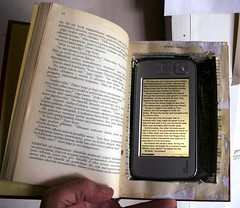
But when you’re walking around all day, or in class, or flying on a long trip, or commuting to work having a convenient way to consolidate your favorite reads isn’t such a bad idea. Maybe the book you want is out of print but but there’s a PDF of it online. Maybe you want to keep getting The New Yorker every week and even though you want to keep them around you hate they way they pile up so quickly. There are so many reasons an e-reader is a good idea, it becomes less of an argument and more of a matter of preference. It’s not like those smelly, dog-eared, scribbled-in books we all love so much aren’t going to go away any time soon. I for one, am glad to have the choice.
This is a major day for doubleTwist. doubleTwist is an iTunes alternative that is similar in appearance but exceeds in functionality because it can sync with more than just iPhones and iPods. iTunes can only sync with Apple products while doubleTwist can sync with just about any device. doubleTwist and T-Mobile have formed a partnership where doubleTwist software will come preloaded on future Android phones.
Read more:
This means if you get a future Android phone from T-Mobile and plug it in to your computer doubleTwist will be installed (if you want it of course). This is beneficial for doubleTwist because it is relatively unknown and with this agreement their mind share will increase. Mind share is how much of the population knows about a product. This will also benefit future Android buyers on T-Mobile because it will give them a program to start syncing media to their phone right away rather than having to drag and drop. doubleTwist also offers purchases from Amazon’s mp3 store so you don’t have to buy from iTunes. Though for some unknown reason T-Mobile has omitted this feature when it comes preloaded on future Android phones. You can download doubleTwist for free from their website: www.doubletwist.com.
Every one by now is familiar with N900 being a great phone with lot of capabilities but as it comes with Maemo 5 OS not much people use it and is not that popular as Google Android is getting everyday. Recently a person called Brandon Roberts has managed to get Nokia N900 to dual boot Maemo and Android which is amazing news to everyone, still a proof of concept but from the video posted it seems pretty usable.
For N900 users there are still no direction how to do that, but hopefully detailed guides on how to do that would be available as majority would want to dual boot there Nokia N900.
I finally got my Nexus One last week and after having fallen out of love with Androids maturity after the Hero I was not expecting much. But I must admit to being highly impressed with this phone.
At the same time as getting the phone I was kindly asked to beta test Slidescreen.
Slidescreen is an app that was advertised on the Larva Labs site at least 6 months ago as a revolutionary home screen for Android. But it didn’t exist. It was just an idea. This disappointed me. It could have really been the application to make the rather dull looking Android a serious contender.
But it’s here!
I love the way I have all the information I am interested in on one screen in a neat and not overloaded layout. Each icon on the end of a section symbolises a service and acts as a launcher.
This allows me to call the most commonly used components on a smartphone without having to navigate anywhere else on the phone.
The middle section of the Slidescreen also acts as an expandable divider. You can drag it up to show all items for any one service that is displayed below it (Google Reader or Twitter) :
Or you can drag it down to show all items for any one service that is displayed above it (Telephone, Messaging, Email, Calendar).
All in all, I believe that Slidescreen heralds the puberty days of Android are closing. Larva Labs have shown that the Android can be as swish as anything else out there. Surprisingly, it does this by mimicking a style employed in the early days of smartphones by adopting a very Palm and early WinMo layout, but the fact is it works.
I just love it and it really sets the Nexus One off. It shows off the fabulous large screen and clarity of the Nexus One.
Another one of my favourite apps is WaveSecure.
Wavesecure help secure your phone by giving you the ability to track where it is, remotely wipe data from it or lock the phone down. It can also sound alarms if the SIM card is switched!
But this application is actually geared towards protecting your data and not your phone. The feature I find valuable are the backup tools. You can backup your contacts AND text messages.
Useful if you hold confidential data on your phone or if, like me, you regularly wipe your phone because you have installed something you shouldn’t. :S
My next application is Trapster.
Trapster warns of speed traps and allows you to upload new speed trap locations to the community of Trapster users.
It’s nice to have on whilst driving. A womans voice warns you when you are close to a speed camera if you can’t see the screen for any reason.
Now onto the low level and system applications.
My first Android device was the Hero. It wasn’t a bad phone, it just wasn’t a great one. It was too small to be considered as a great phone. The software was a little flaky, the processor was under powered and the keys were in a strange position that were not practical.
But the Nexus One and Android have rectified all of these errors. Along with the bigger screen is a high quality screen. The software has matured to have a sleek feel to it. The “clunk” of cupcake has gone. The processor is almost twice as fast as the Hero and the keys are much better placed.
The system applications have been upgraded too. First off, “Running Services”. This is the Android “Task Manager”. But instead of displaying all the processes including the low level processes with ’scary’ names they have been neatly grouped inside section with more user friendly headers.
The ‘Applications’ list now has 3 filters. Downloaded, Running and All. Which makes it easier to scan and read than Cupcake.
The Battery Usage screen is a very useful one. It displays what services used your battery the most. Sometimes it is the display, sometimes it is the amount of calls you made. Other times it could be an application. Either way, you can find out what is making your battery run down.
All in all, I am loving the Nexus One. I love the screen size, I love the look and feel of the phone. I like the fact that it integrates into Google applications so well – as you would expect seeing as Google maintained the development on this one. I love the fact that I can run around the OS as quick as I like with no lag. Not like the Hero. I love the fact I can downclock the CPU and it *still* runs quick.
Is it an iPhone killer? No. But these reason is because it plays a different sport to the iPhone. You can’t compare the two. It would be like comparing the Wii and the PS3, they are completely different machines aimed at completely different markets.
The Nexus One has a quality build physically and technically. A lot of the applications I used to install to solve short comings in the Android system are not necessary any more as Google have fixed the problems.
I would highly recommend Nexus One if you like Android. Sure, it doesn’t have the software support of the iPhone, but it’s only a matter of time…..
 Thanks to a tip from one of our readers (thanks Gerard!), it appears that there’s a huge data outage for Nexus Owners (s goog) on the T-Mobile network. I’ve verified the issue on my own Nexus One and just did a little digging. According to forums at both T-Mobile and XDA-Developers, it’s a wide scale issue and nobody seems to have an answer. One would hope that this has something to do with fixing the 3G issues on the handset, but I think that’s an overly optimistic view. The fix would likely be announced from Google or HTC, for starters and it wouldn’t hamstring the entire T-Mobile network for Nexus One owners.